
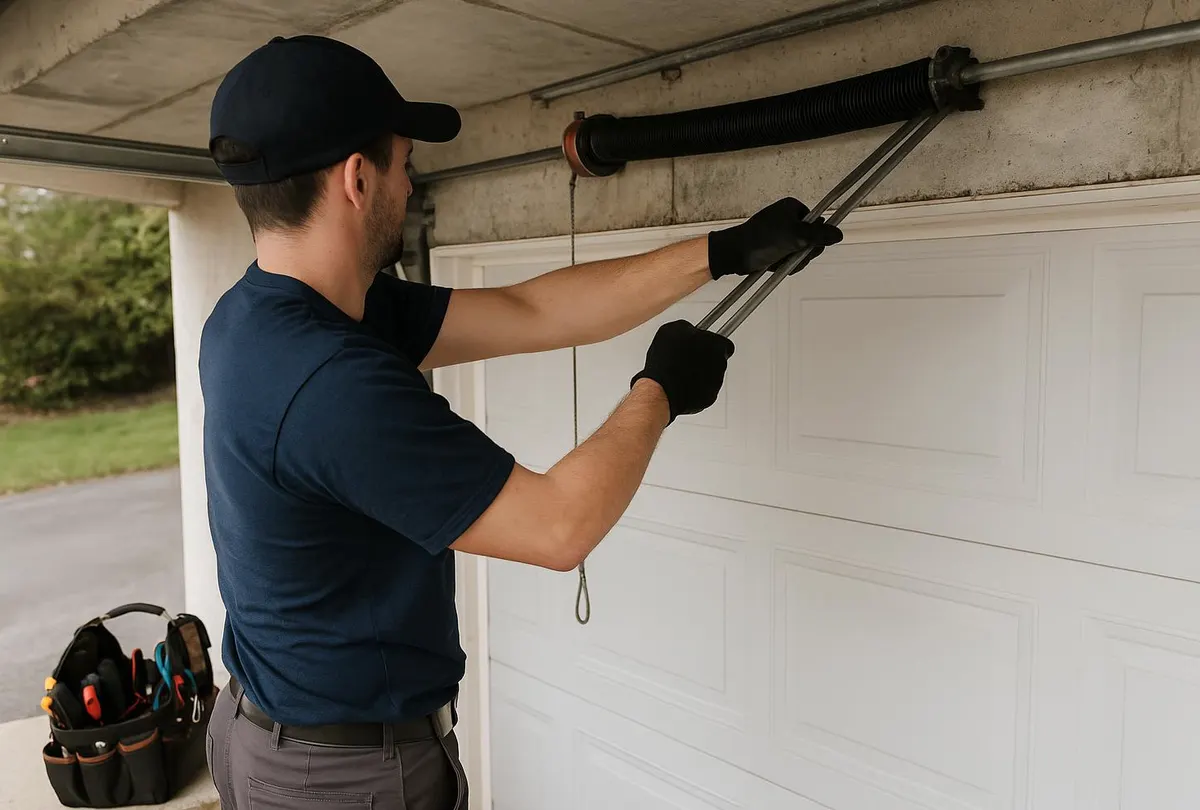
It's usually one of you standing in the driveway watching the door start to close, stop three-quarters of the way down, and reverse back up. Or it's the other way around: the door comes down and hits the concrete with a bang loud enough to make you wince. One of you says "just turn up the force, it's being stubborn." The other says "that seems like a bad idea." You're both a little right, and the disagreement usually comes down to not knowing what force and travel limits actually do.
Two Different Settings, Two Different Jobs
Every garage door opener built in the last few decades has two separate adjustments buried in a panel or learned through a smartphone app, and they are not the same thing.
Travel limits tell the opener exactly where "fully open" and "fully closed" are. Think of it as the opener's memory of distance. If the travel limit for closing is set too short, the door stops a few inches above the floor and thinks it's done. If it's set too long, the opener keeps driving the door downward after it's already touched the ground, straining the chain or belt and the door panels.
Force limits tell the opener how much effort it's allowed to use to get the door that distance. This is the setting tied directly to safety. If the opener senses resistance beyond the force limit, mid-travel, it's supposed to assume something is in the way and reverse. That's the same mechanism that stops a door from closing on a bike, a cooler, or worse.
So Which One Is Actually Wrong?
The symptoms tend to point in different directions:
- Door reverses before reaching the floor, with nothing in the way: usually a travel limit that's slightly off, or a force limit set too low so normal friction trips it.
- Door slams down hard or struggles and grinds going up: often a force limit set too high, sometimes masking a real mechanical problem rather than fixing one.
- Door closes, then immediately reopens on its own: classic mismatch between the two settings, or a sensor alignment issue being misread as a limit problem.
Why "Just Turn Up the Force" Is the Wrong Instinct
Cranking the force dial higher is tempting because it almost always makes the symptom go away in the short term. The door stops reversing, it closes all the way, everyone moves on. The problem is that a door that needs more force to close usually needs more force because something else is wrong, not because the opener was set too gently.
Common reasons a door suddenly needs more muscle:
- Springs losing tension (torsion springs weaken gradually and more sharply if they're approaching the end of their cycle life)
- Rollers or hinges that have picked up rust or salt residue and no longer roll smoothly in the track
- A track that's shifted slightly out of alignment
- A wood or wood-composite door that's absorbed humidity and swollen just enough to bind
In Gulf Coast conditions, that last one is more common than people expect. The combination of heat, humidity, and salt air that rolls in off the water accelerates both the swelling and the corrosion side of this equation. A door that closed easily in April can start fighting the opener by August, not because the opener weakened, but because the hardware and the door itself changed.
When you raise the force limit to push through that resistance, the opener wins the fight against the real problem, which means the real problem keeps getting worse. Gears wear faster. Cables and rollers that are already struggling take more strain. And critically, the opener's ability to detect an actual obstruction gets duller. The safety standard most residential openers are built to requires the door to reverse on a relatively small amount of resistance, around two pounds, specifically so it can detect a small child, a pet, or a bike before real damage or injury happens. Setting the force high enough to brute-force a binding door past that threshold undermines the exact feature that makes an automatic garage door safe to operate around a family.
What Actually Fixes It
The right sequence is almost always: find out why the door is harder to move, fix that, and only then fine-tune the limits. That usually means checking spring tension, inspecting rollers and hinges for corrosion or wear, confirming the tracks are square and properly spaced, and making sure the door itself is balanced (a door that doesn't stay roughly in place when manually lifted halfway is a spring problem, not an opener problem). Once the door moves smoothly by hand, the opener's force and travel settings can be adjusted to modest, correct values rather than cranked up to compensate.
Hurricane season adds one more wrinkle worth knowing: strong wind pressure against the door can occasionally interfere with how the opener reads resistance during a storm, which is a separate issue from day-to-day limit settings and not something to chase with permanent force adjustments.
When to Call Precision Garage Door of Crystal Beach
If you've bumped the settings a few times and the door still won't behave, or if it's fighting the opener more than it used to, that's the point to stop adjusting and have it looked at. Our technicians check the whole system, not just the opener, which usually means inspecting spring tension and rollers as part of a Garage Door Maintenance & Tune-Up, and replacing worn Cable & Roller components if salt air or age has taken its toll. Once the door itself moves the way it should, we set the force and travel limits to the correct, safe values, so the opener isn't doing extra work it was never designed for.
If your garage door in Crystal Beach, FL is fighting its opener, slamming shut, or reversing for no clear reason, call Precision Garage Door of Crystal Beach and we'll find out what's really going on before anyone touches that dial again.